
Simple Jobs In Two Amplifiers – JBL Libra 250 & Sonance Sonamp 260X3
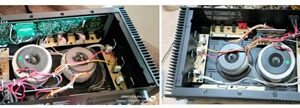
Occasionally we get blessings of simple problems in sets and these two were such, which interestingly came from two different customers on successive days. Both Amplifiers were of international repute and that is why I chose to send this report to you all:
Case (1) – JBL PUBLIC ADDRESS SYSTEM MODEL LIBRA 250:

This was brought to me by a known person with the complaint that the volume increased to very high level suddenly on its own and since it was used in a reception area, where patients wait, it caused sudden jerky shocks to them. I took it on priority and opened the cover and subjected it to a thorough cleaning.
Such problems are normally due to dirt and dust collection inside the potentiometers and/or dry solder joints. Let us have a look of inside of this lovely Amplifier:

As suspected, the master volume control was having the issue. In order to remove the control panel fit in the front, we need to remove all the knobs and the nuts holding the pots in place. Let us have a look:

Then I desoldered one of the potentiometers to check whether any oil can be applied from the bottom:

As you can see it was a 10K pot of A type (Linear type). This Amplifier used A type for tone controls and B type (Logarithmic) for volume controls. The values were 10K, 20K and 500K. As the contacts were concealed, I could only spray the cleaner through the gap in the turning knob and a small hole in the middle of the pot at the bottom side.
I did that with every control after removing it. Then applied cleaning oils on all the switches on the front panel. I turned all the pots back and forth vigorously to enable even spreading of the cleaning spray that is assumed to have reached the leaf contacts.

Then refit the panel and inserted all connectors in place. Then played a USB and tried all controls and did not find any noisy disturbances.

Case (2) – SONANCE AMPLIFIER MODEL SONAMP 260X3:
This was brought by another customer with the complaint that it was found dead on one day when he tried to use it. I opened the set and cleaned it thoroughly.

As most of you would have already noticed, this Amp did not have any volume or tone controls as this was to be used with a pre-Amp. There was only one on/off switch with three selector switches for the speaker connections. This worked on 110V and the customer had brought the 230V AC to 110V AC converter transformer along with it. We technicians should always be aware of such varied inputs in sets received for service and if we don’t take care of this aspect, we might end up coughing up a lot of money in restoration works apart from attracting bad reputation and rebukes as well from the customer.
I noticed that one of the AC fuses had blown. Before replacing I checked the inside thoroughly and found fungus formation in one of the legs of the output transistors. I just cleaned it using IPA, but forgot to click it before doing so.
Then checked for any more burnt, damaged or defective components. Could not find any. Then replaced the fuse and applied power, upon which the Amp was found working very well. I gave input signal from a USB player and allowed it to run for a few hours before closing the cover. Let us have a look at a couple of pictures which I took as an extract from the video that I had shared with the customer:

Missions accomplished with double satisfaction getting added to the collection.

This article was prepared for you by Parasuraman Subramanian from India. He is 74 years old and has more than 30 years’ experience in handling antique equipment like Valve Radio, Amps, Reel Tape Recorders and currently studying latest tech-classes conducted by Kerala State Electronics Technicians’ Association. He has done graduation in BBA degree, private diploma in Radio Engineering and retired as MD of a USA company. Presently working as Consultant to Hospital and other institutions.
Please give a support by clicking on the social buttons below. Your feedback on the post is welcome. Please leave it in the comments.
P.S-If you enjoyed reading this, click here to subscribe to my blog (free subscription). That way, you’ll never miss a post. You can also forward this website link to your friends and colleagues-thanks!
You may check on his previous article on Saving Computer SMPS Part – 14
 (36)Dislikes
 (0)
(0)
16 Comments
Leave a Reply





Waleed Rishmawi
July 26, 2025 at 9:40 pm
We as technicians deserve an easy repair job once in a while so it is ok. Cleaning the knobs is ok but I think replacing them is the way to go. Have a blessed day
Parasuraman S
July 27, 2025 at 7:59 am
Replacement was not available. Many thanks, dear friend!
douglas
July 26, 2025 at 9:46 pm
i love that you desoldered that pot just to see if it could be oiled from the other side; so cool!
Parasuraman S
July 27, 2025 at 8:00 am
We, technicians, should never leave any stone unturned when we take up some repair work! Many thanks!
Albert van Bemmelen
July 27, 2025 at 12:27 am
Although the amplifier in case 1 was fixed by cleaning and oiling all pots and checking all contacts it remains to be seen how long this fix will work.
Parasuraman S
July 27, 2025 at 8:01 am
Yes, we have to wait and see! Unfortunately, replacement was not available!
Yogesh Panchal
July 27, 2025 at 1:08 am
Good Job! Sir,
Amplifiers look neat & new condition.
Parasuraman S
July 27, 2025 at 8:02 am
Yes, very true!
Eric Rice
July 27, 2025 at 2:50 am
Thank you for the repair article, you’re always thorough in your repairs. By the way, A pots are logrithmic/audio types and B pots are linear. I’m sure it’s an accident, but you have it backwards in your article.
Parasuraman S
July 27, 2025 at 8:03 am
Probably yes! Might have been a mistake! Many thanks for pointing it out.
Robert Spoon
July 27, 2025 at 9:18 pm
Parastatal great article as usual, a technique I have employed to clean controls like this when they are not available for replacement is to put a drop of alcohol on the shaft of the pot and then the cleaning solution followed by a puff from compressed air. The alcohol seems to thin the solution enough to get to the contacts and wafer inside.
Parasuraman S
July 28, 2025 at 9:45 am
Good suggestion! Shall try next time! Many thanks!
Mark J
July 27, 2025 at 2:56 am
Parasuraman good job on the repair. I always look forward to your articles. Thank you again for sharing.
Parasuraman S
July 27, 2025 at 8:04 am
Many thanks, dear Mark!
Robert Spoon
July 27, 2025 at 9:22 pm
Sorry for the misspelling on your name but spell check strikes once again leaving dissatisfaction escaping into my bag.
Parasuraman S
July 28, 2025 at 9:47 am
Its ok! Thanks! Auto corrections do make our typing complicated!