
LG Home Theater Model DH3140S – Dead on Arrival, Now Repaired
I received this LG home theater from a customer who wanted it checked by a technician. It was completely dead on arrival, so I started with the basics.

I checked the main fuse and found it open. For testing purposes, I used a jumper wire across the fuse and connected the unit to my series bulb current limiter.

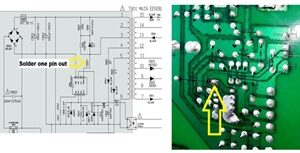
When I applied power, the bulb lit up brightly—like the midday sun. That’s a clear sign of a shorted component on the primary side of the power board. My first suspect was the IC902 (STR-W6053S). Instead of fully removing the IC, I de-soldered FB902, which acts like a jumper for the VCC.
I powered the unit again through the series bulb, but the bulb still glowed bright—so this IC was not the problem.

Next, I suspected IC901 (ICE38R476S). I removed FB901 and applied power again—still, the bulb stayed bright. Time to move on.

The next suspect was the bridge diode. My meter showed it was fine, but to be certain, I removed it completely out of circuit. When I powered the unit, the bulb went dim—bingo! The bridge rectifier was indeed faulty.

I replaced it, and the short was gone. Feeling confident, I powered the unit without the series bulb, but it still didn’t fully power up.
I continued testing components and found D901 (SUF4007) completely shorted.
I replaced it with an FR series diode, powered the unit, and it greeted me with a “HELLO” message—progress!

The unit was now working, but the audio was very low. On closer inspection of the mainboard, I noticed a burnt area.
After removing the board, I saw that some copper tracks had burned out from overheating.

I rebuilt the damaged tracks with wire jumpers, powered up again, and the audio was fully restored.
The LG home theater is now working perfectly—full audio, no faults. The customer was delighted, and I was equally satisfied to have solved the problem.
Tech Tips
- Always use a series bulb current limiter during initial tests—it can save components (and your fuse stock).
- Never trust the meter alone—a bridge rectifier can test “good” yet fail under load.
- Visually inspect the board—burnt areas often hide open tracks or deeper damage.
- Document your steps—this helps in future similar repairs.
Want to take your electronics repair skills to the next level?
Grab your copy of Home theater repair guide – a practical, easy-to-follow guide packed with real solutions, pro tips, and step-by-step fixes.

Humphrey Kimathi is from Nairobi Kenya and the author of:
1) Lcd-Led Television Repair Guide
2) LCD-LED Television Repair Cases/Tips Volume 02
3) Microwave Oven Repair Made Easy
Please give a support by clicking on the social buttons below. Your feedback on the post is welcome. Please leave it in the comments. If you have electronic repair articles to share with us, please contact us HERE.
P.S- If you enjoyed reading the above article, click here to subscribe to my blog (free subscription). That way, you’ll never miss a post. You can also forward this website link to your friends and colleagues-thanks!
Note: You may check out his previous post on Ramtons Microwave Oven Model RM206 “No Heating Problem” Now Repaired
 (38)Dislikes
 (0)
(0)
28 Comments
Leave a Reply





Waleed Rishmawi
August 23, 2025 at 5:23 pm
good work but usually when there is a short and the fuse is open the first thing I would check is the bridge rectifier and then from there i move on. good job though you found the faulty parts and got it fixed. have a blessed day
Humphrey Kimathi
August 24, 2025 at 12:48 am
Thank you so much for your feedback and encouragement. You’re absolutely right—whenever a fuse is open due to a short, the bridge rectifier is usually among the very first suspects to check.
Interestingly, it initially tested “good” with the meter but failed under load, which is why I had to confirm by removing it from the circuit and testing again. Thanks for pointing that out. May you also stay blessed in your repair journey!
Parasuraman S
August 23, 2025 at 5:35 pm
Reading the article, I knew it might be from a professional expert! Yes, indeed it was from one of my favorite authors, none other than Humphrey Kimathi! Many thanks for this wonderful article, dear!
Humphrey Kimathi
August 24, 2025 at 12:51 am
Wow, thank you so much for the kind words . I truly appreciate your support and encouragement—it means a lot! Glad you enjoyed the article, and may you continue to be inspired in your repair journey. Blessings!
Tito Kanshulu
August 26, 2025 at 4:55 pm
Welcome to the fold Humphrey Kimathi. It has been a long time since we heard from you. Your articles are quite refreshing. Keep the good work
Humphrey Kimathi
August 26, 2025 at 11:56 pm
Thank you so much. Yes, it’s been a while, but I’m glad to be back. I truly appreciate your encouragement—it motivates me to keep sharing. Blessings!
Albert van Bemmelen
August 23, 2025 at 6:03 pm
This LG home theater seems to be a well designed device seeing those easy removable FB90X voltage supply input components.
Nice and detailed repair Humphrey! And being able to download the matching service manual is another reason to buy this brand 300 watt RMS 5.1 audio channel output dvd player with matching 3 ohm speakers.
Humphrey Kimathi
August 24, 2025 at 12:53 am
Thank you for the great feedback . Yes, the LG DH3140S is indeed a well-designed unit—those removable FB90X links really make troubleshooting easier. And you’re right, having the matching service manual on hand is always a big advantage. Glad you enjoyed the detailed repair!
Mark
August 23, 2025 at 6:37 pm
Well done Humphrey. A good diagnostic process
Humphrey Kimathi
August 24, 2025 at 12:55 am
Thank you so much . Careful step-by-step diagnosis is always the key to finding the real fault without causing more damage. I really appreciate your encouragement!
Kings
August 23, 2025 at 6:52 pm
What is series bulb current limiter
Humphrey Kimathi
August 24, 2025 at 1:02 am
A series bulb current limiter is a very simple but powerful tool for safely powering electronic devices under test, especially when you suspect a short circuit or fault in the power supply.
How it works:
You connect a normal incandescent bulb (60W–150W) in series with the device you’re repairing.
When you power on, the bulb acts like a current limiter.
If the device is okay, the bulb will glow dimly or briefly flash and then go dim.
If the device has a short circuit, the bulb will glow brightly, taking the excess current instead of letting it damage your components or blow the fuse.
Why it’s useful:
Protects your device and new components from further damage.
Saves you from wasting fuses.
Gives you a visual indicator of whether there’s still a short in the circuit.
Regards Humphrey
Yogesh Panchal
August 23, 2025 at 11:59 pm
Good Job !Sir
Getting Article from you side after so long time.
Humphrey Kimathi
August 24, 2025 at 1:08 pm
Thank you so much. Yes, it has been a little while, but I’m glad to be back sharing again. I truly appreciate your support and encouragement—it keeps me going!
Mark J
August 24, 2025 at 7:49 am
you are right about never trust the meter alone. Good article thank you for sharing.
Humphrey Kimathi
August 24, 2025 at 10:17 pm
Thank you. Yes, meters can sometimes be misleading—that’s why double-checking under load or out of circuit is so important. Glad you enjoyed the article!
Joshua oloo
August 24, 2025 at 2:15 pm
Thanks for the article Hump.incase the bridge consist of four individual diodes,can you remove them all when you are testing for short in SMPS?Thanks
Humphrey Kimathi
August 24, 2025 at 10:21 pm
Thanks for the great question. Yes, For individual diodes, it’s best to lift one leg of each diode and test them out of circuit. That way you avoid false readings from surrounding components. If any diode shows short both ways, then you’ve found the culprit.
Muykit
August 24, 2025 at 6:44 pm
You are such a great instructor-come-repairer-come-writer . Im happy to read a fresh article from you. Its often hard to locate a short circuit, particularly in secondary power supply in general. Im wondering, Humphrey that you came up after a long time with a DVD player repair. I really miss alot the nice machines that operated year in, year out, without presenting any problem and they could be easily repaired with simple solutions, and, spare parts for fake CD/DVD players were always available and they were a blessing to repairers, moneywise. Its sad that these machines have largely gone missing from shop shelves, living room cabinets and technician work-benches since the advent of digital tv transmission. Anyway as I said secondary short circuit are quite a headache to nail down. I, once in a while do electronic repairs in the village and come across short circuits in faulty free-to-air set top boxes having tiny SMD components hard to go around during trouble shooting. Regards, fellow countryman.
Humphrey Kimathi
August 25, 2025 at 12:41 pm
Thank you so much for your thoughtful comment . You are right—tracking down short circuits, especially on the secondary side, can be one of the toughest parts of repair work. It takes patience and step-by-step elimination to get to the real culprit.
I also share your sentiments about the older DVD players—they were solid machines, easy to service, and with spare parts readily available. Truly a blessing to technicians in those days. Nowadays, with digital TV and compact SMD-based devices like set-top boxes, repairs can be more challenging, but the principles remain the same: systematic troubleshooting, proper tools, and persistence.
I’m glad to hear you’re still taking on repairs even in the village setting—keep it up, brother. May you continue to enjoy the craft and bless others with your skills!
Imoudu.O
August 25, 2025 at 3:49 am
Ah...my nice friend,it's been so long,I've been wondering,perhaps u are into other buz and very busy,I'm so glad to have ur acticle again.
I can't wait to read the "other side".Have a blessed day.
Humphrey Kimathi
August 25, 2025 at 12:46 pm
Ah, thank you, my friend. Yes, it has been a little while, but I’m glad to be back sharing again. I truly appreciate your patience and support. The “other side” is coming soon—stay tuned! Have a blessed day too.
Henrique Jorge G. Ulbrich
August 25, 2025 at 10:33 pm
Very good, Humphrey. For both, the repair article and your English writing. I didn´t got to understand what the FB902 is. Is it an IC? I tried a Google search but didn´t succeed.
Humphrey Kimathi
August 26, 2025 at 11:03 pm
Thank you so much for the kind words, I really appreciate it. FB902 is not an IC—it’s a ferrite bead jumper (like a small inductor or zero-ohm link) used for filtering and as a convenient connection point. In this repair, I lifted it to isolate the VCC supply for testing. That’s why you may not have found much info on Google—it’s usually marked as FB (Ferrite Bead) on schematics rather than as a standard component.
Vusi S
December 27, 2025 at 2:31 pm
Hello Sir, I have been looking for a service manual for this DH314oS.
Board is burnt near IC 701 and 702 so a diagram can help me to rewire it.
Please assist where can I buy the diagram cause I tried several sources with no luck
AdamS
August 26, 2025 at 6:28 pm
As per the circuit diagram above, FB902 is simply the circuit reference of the inductor (or ferrite bead - hence "FB") that connects the main supply to IC902.
Nice to see you back again Humphrey!
Henrique Jorge G. Ulbrich
August 26, 2025 at 9:21 pm
Thanks, AdamS.It elucidated it.
Humphrey Kimathi
August 26, 2025 at 11:07 pm
Very nice Adams, you have put it so well.... Thanks a lot, and it’s great to be back sharing again!