
How Much Human Abuse Can A Device Take? – Case Of Mr King Induction Cooker-ORION-888
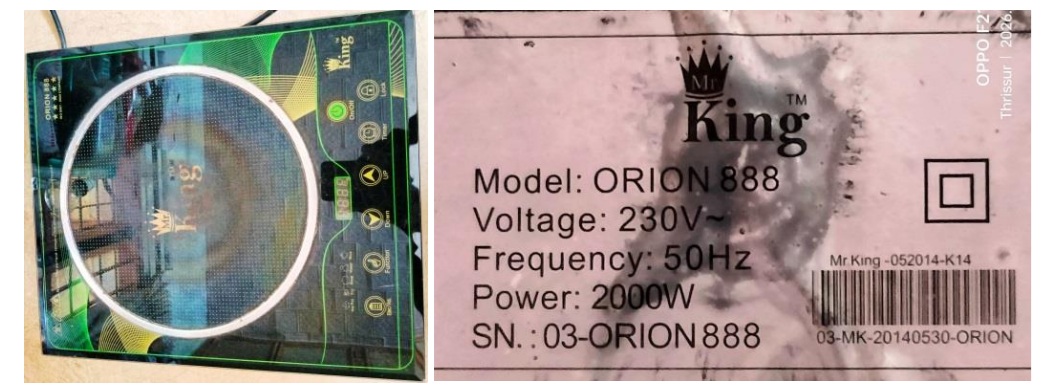
This induction cooker (hereinafter referred to as ‘IC’ for brevity) was brought to me with the complaint that it gets on, but stops immediately. I checked and confirmed the same on my table too. But I was awestruck when I opened the IC for cleaning. Please have a look:
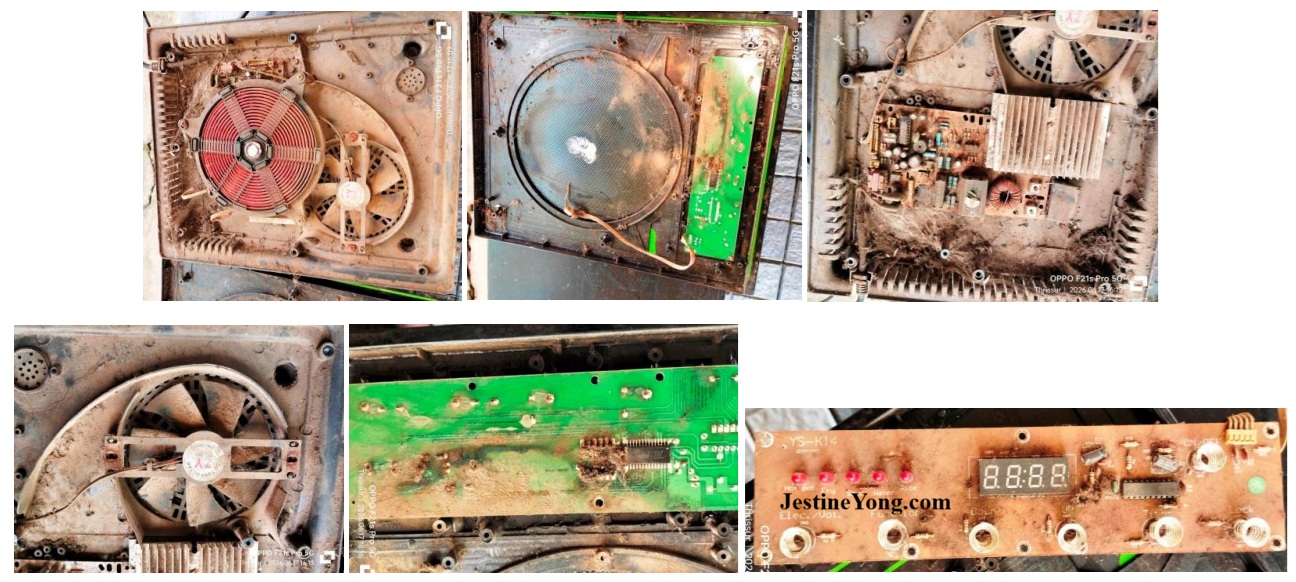
It took me well over a couple of hours for cleaning the inside using blower and various brushes. The fine dust had settled so well that one might mistake it as a design! Now look at the rust formations on jumpers and components:
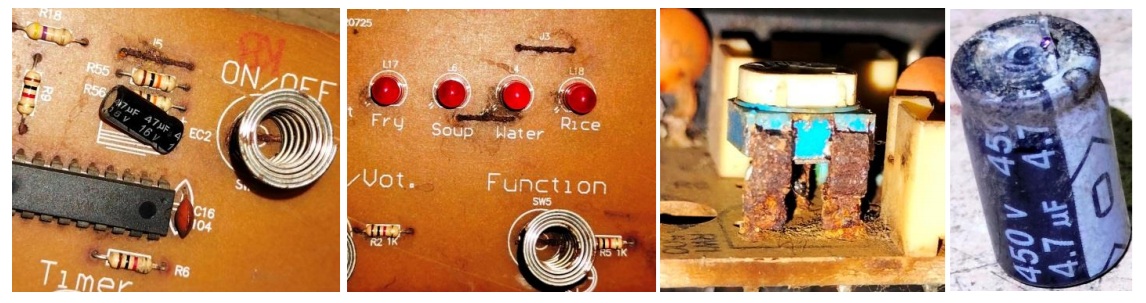
The condition of a capacitor when removed can be seen in the last picture above, which I placed it there to save space. Hope your doubt about the caption of this article is cleared now! How did this device even get on, leave alone working!
I completed the tedious work of replacing all rusted jumpers and components. I also replaced the 8050/8550 transistors which is a routine maintenance work in the IC. The high value resistors were checked, removing one side and replaced wherever the values had exceeded. All the fixed caps were also changed in the IC as many of them had formation of rust in the legs. Then after preliminary cleaning, a complete retouch of the board was carried out. As for the potentiometer of 500 Ohms, I put a new one just copying the position of the old one as it was in such a bad condition that no measurement could be made. The 7805 regulator was a big size regular one and not the 78L05 transistor type. So, that was not replaced.

Click here to check out Electric Cooker, Induction & Oven Repair Guide
The black capacitors were removed and checked for compliance of the value. Then cleaned the boardonce again using IPA. Let us see how the board looked then:
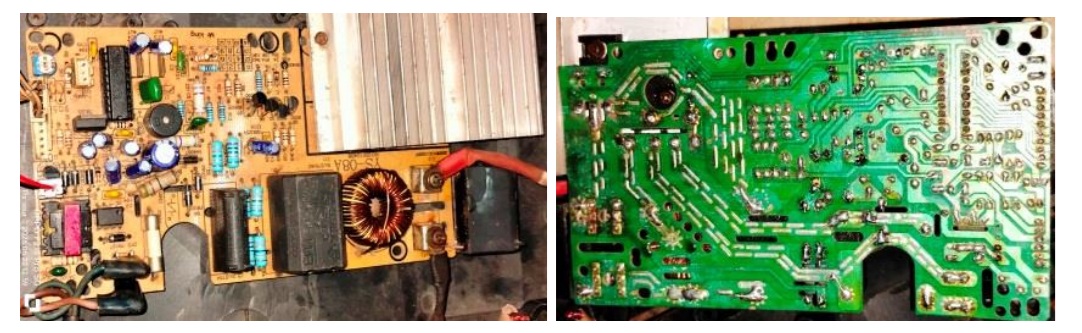
Now the twist started! After checking and rechecking the board once again, assembled the boards with its coil in place, and applied power. The fan was not rotating, even though I had dismantled it and cleaned and lubricated. Probably because of the rust formation inside. So, replaced it. It got on with a crystal clear display and responded to all buttons.
Then I kept a testing glass-ceramic plate and a pot with water on it and checked. The induction started but stopped with a beep and again started and stopped with a beep. This was going on without any break. I even tried adjusting the pot a bit this way and that way. But nothing stopped this. Once again dismantled and looked for any trouble making spots or components and could not find any. I sent an SOS to my techie friends, some of whom wanted me to replace the pot and readjust it. But as I was sure of its function being a new one, I did not heed to this suggestion! But as other works got mounted up like TVs affected by rain and lightning, I got diverted and this was lying in one corner unresolved. As the pressure of other work did not give a gap, I sought help of a local techie, who obliged me. I went there with the IC and he checked everything once again. He removed the round inductor coil near the black cap and cleaned the bottom side once again. He also looked for any wrong components replaced. That’s how he found out the mistake! I share the following photos and can any one of you guess what?
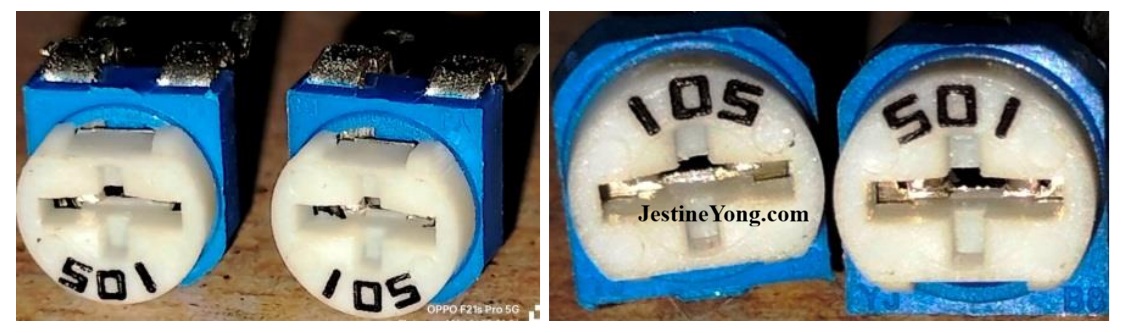
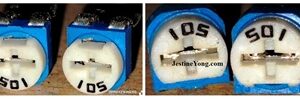
The technician found out that I had used a 105 pot instead of a 501 pot (1 meg instead of 500 ohms). He found out that because of his expertise in handling ICs! He tried to adjust it to 220 Ohms and that is how he noticed that at mid position itself, it was showing 500 Ohms and the pot was that of 1 Meg and not 500 ohms. So, he replaced it with another suitable one from his stock and adjusted it to 220 Ohms. Hurray! The IC started working very well as the root cause got resolved. He was focusing on this as the display was not going off when the beep sounded and no error indication was also there. The heat sensing was erratic due to the wrong setting of the potentiometer! I was happy that the IC was back to working condition.
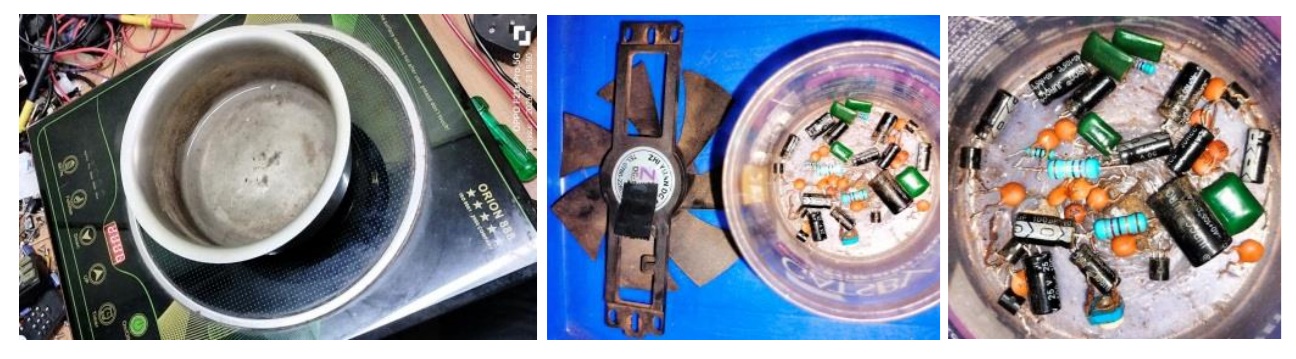
I had to forcibly pay his charges even though he declined to take any. I came home and checked how I made that mistake. When I looked into the box where these are arranged in separate slots, I noticed that a couple of 105 pots were mixed up with 501! So, that was it! If I had to adjust the pot after measuring the old one, I could have found out this mistake. But that was not possible as I kept it only looking at the position without carrying out any measurement. Anyhow, mission got accomplished with double satisfaction of education in completion, which got promoted to the collection bag! Here are a few concluding pictures:

This article was prepared for you by Parasuraman Subramanian from India. He is 76 years old and has more than 30 years’ experience in handling antique equipment like Valve Radio, Amps, Reel Tape Recorders and currently studying latest tech-classes conducted by Kerala State Electronics Technicians’ Association. He has done graduation in BBA degree, private diploma in Radio Engineering and retired as MD of a USA company. Presently working as Consultant to Hospital and other institutions.
Please give a support by clicking on the social buttons below. Your feedback on the post is welcome. Please leave it in the comments.
P.S-If you enjoyed reading this, click here to subscribe to my blog (free subscription). That way, you’ll never miss a post. You can also forward this website link to your friends and colleagues-thanks!
You may check on his previous article on The Inside Of A USB Portable Rechargeable Soldering Iron
 (29)Dislikes
 (0)
(0)
10 Comments
Leave a Reply





Albert van Bemmelen
September 20, 2026 at 12:56 am
WOW! This clearly shows how even after much preliminary cleaning and solder patching work a small unnoticed wrong read part can cause so much trouble!
Glad that afterwards your timeconsuming cleaning and replacing all bad parts was not invain!
Parasuraman S
September 20, 2026 at 11:20 am
Yes, otherwise it would have been an ever-bothering pain! Many thanks, dear Albert!
Mark J
September 20, 2026 at 3:10 am
Good job Parasuraman . You are an expert at fixing induction cookers.
Parasuraman S
September 20, 2026 at 11:21 am
Can't say expert! There are many more unknown functions to learn from different models! Many thanks, dear Mark!
Yogesh Panchal
September 20, 2026 at 5:02 pm
Good Job!Sir
Even when we work on the same type of device for years and become experts at it, mistakes can still happen under a heavy workload. Technicians like us—often called "jacks-of-all-trades" because we never turn down a job—face certain challenges; one such difficulty lies in deciphering the confusing markings on faulty open-circuit SMD resistors.
I have now made it a habit to separate components of different values, store them in small plastic pouches, and label each one with a sticker; this makes finding the parts much easier.
Parasuraman S
September 20, 2026 at 11:37 pm
Many thanks for your comments and sharing experiences, dear Yogesh Bai!
Yhoni
September 21, 2026 at 2:40 am
Amazing!! Good job!! congratulations!!.
Parasuraman S
September 21, 2026 at 11:27 am
Many thanks for your comments!
Waleed Rishmawi
September 22, 2026 at 3:02 pm
mistakes happen my friend...should check value even it is sitting in a box marked..that is a very good procedure. have a blessed day
Parasuraman S
September 22, 2026 at 3:41 pm
Many thanks for your comments, dear friend! How are you?