
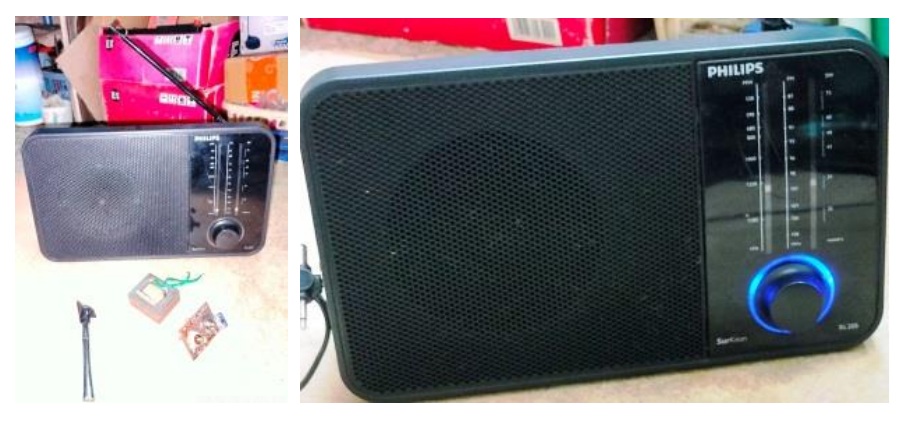
Tuning Problem And Issues In AC Adapter Solved In PHILIPS Radio RL205/00
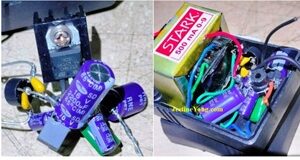
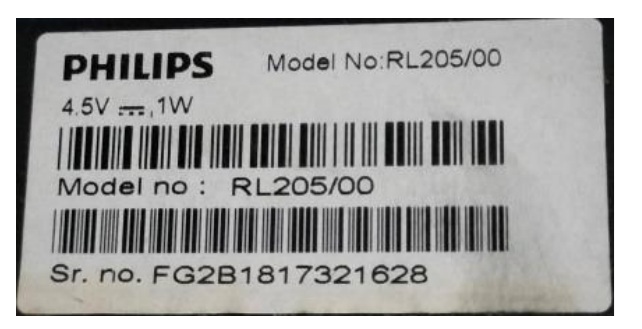
This radio was brought by a recently added regular customer with the complaint that the AC adaptor was not working and the tuning was with crackling noise. I opened the ACA, which had multiple voltage selector switch and a polarity inverter switch. Let us have a look of the inside:
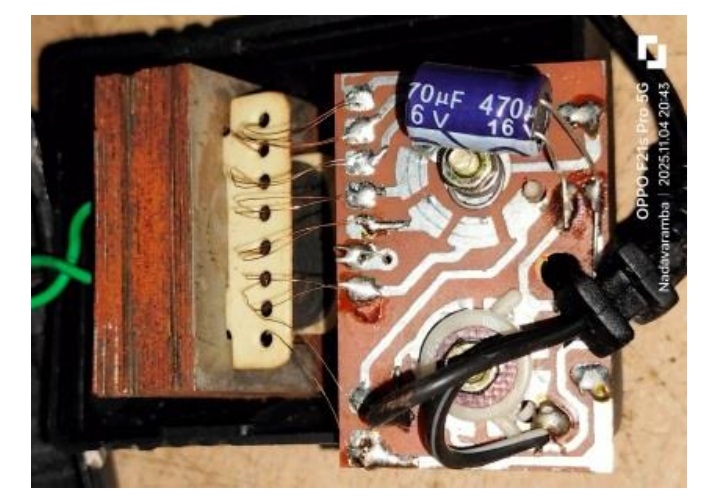
As you can see, there was only a 470uF/16V capacitor inside! One of the flimsy secondary windings was open and I decided to replace it with a proper transformer and circuit to provide 4.5V DC. Though I tried with a 0-6, 500mA transformer with the 5A regulator, the input voltage was not good enough and therefore changed it to 0-9V, 500mA.
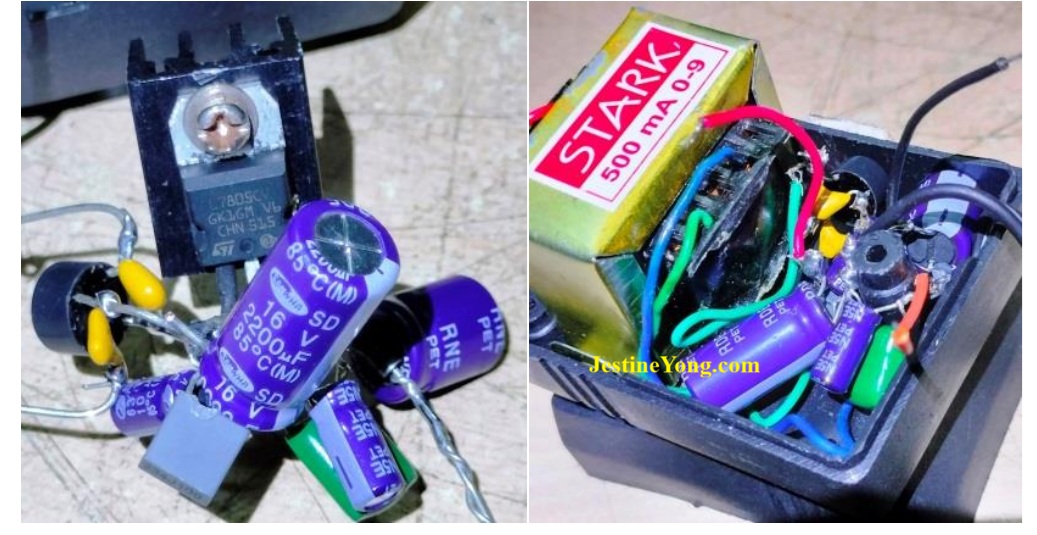
After ensuring that the TX was seating properly, connected a bridge rectifier to the 0-9 V AC and provided two fixed caps of 100nF/100V across the diodes. For the main filter, I used 2200uF/25V. The input voltage was checked to be around 13V. Then provided a heat sink for the 7805 IC and connected two 10uF/63V at the inputs as well as the outputs apart from the fixed caps shown in the following picture:
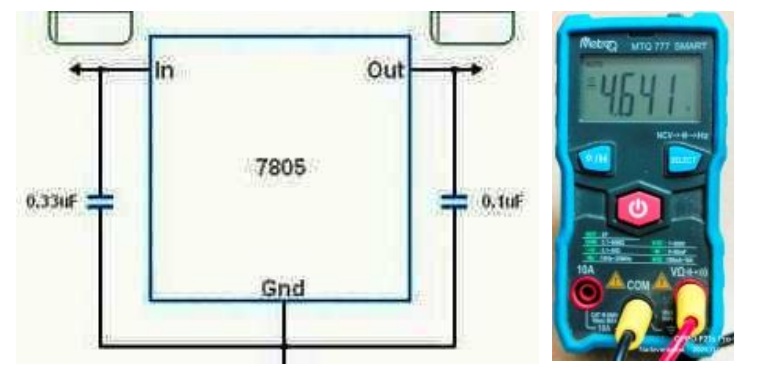
The 5V output was good on checkup. Then provided one IN4007 at the output to drop half volt and added a 2200uF/16V smoothing cap there also. The output was 4.641, which you can see in the second picture above. The next task was housing the circuit inside the secondary section, which I managed by providing lead wires for the regulator.
Though the finished work had a clumsy look, performance was superb when connected to the Radio, as there was absolutely no hum. It worked as though from a DC battery. Let us have a look at the clustered ACA:
Then connected the output wires after checking which pin should get which polarity. In the socket there was a marking that positive should go inside and negative should be in the outer. After ensuring a stable power supply, the next step was tuning stations and find out what made the crackling noise. In this radio, inside of which is exposed below, a 100K potentiometer was used for manual tuning instead of a ganged condenser.
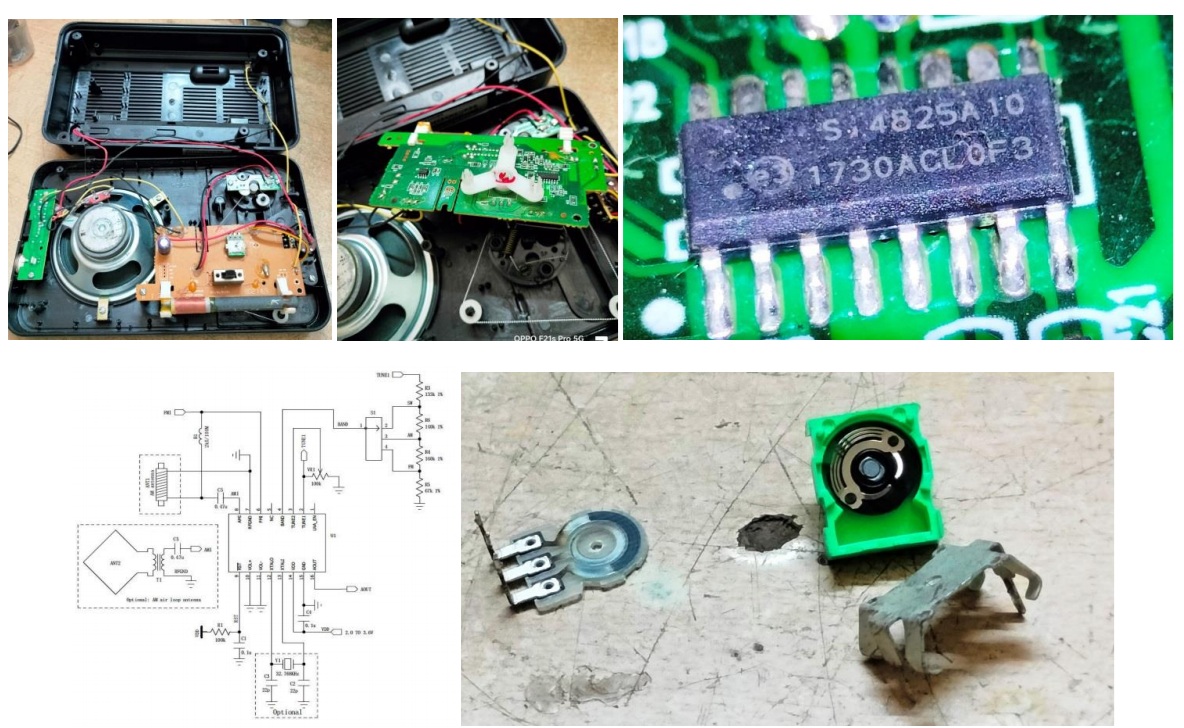
As I knew that the 100K VR was the culprit for making crackling noises, replacement of which was not available in the market, I dismantled it and first cleaned it with IPA and then applied lubricating oil, fixed it back and rotated the spindle a few times clockwise and anti-clockwise to enable self-cleaning. (The second picture above would show you the dismantled VR.) Then fixed it and tried and found that the the crackling noise had gone! The next task was fixing a new TRA as the one in the radio was broken. I used a good quality colour matching TRA after removing the old one and fixed the following extra fittings that are necessary for proper seating of the antenna at the rear.
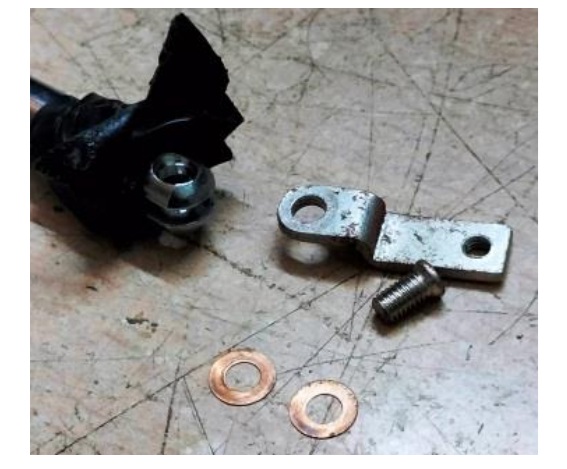
The two copper washers as inserts at both side of the fixing screw are very essential to make proper contact and smooth tilting of the TRA to different directions for better pick up of signals.
Lubricated the volume control and band switch and cleaned it thoroughly by operating them vigorously. Then fixed the back cover with its screws. Mission accomplished with derived satisfaction that got collected!

This article was prepared for you by Parasuraman Subramanian from India. He is 76 years old and has more than 30 years’ experience in handling antique equipment like Valve Radio, Amps, Reel Tape Recorders and currently studying latest tech-classes conducted by Kerala State Electronics Technicians’ Association. He has done graduation in BBA degree, private diploma in Radio Engineering and retired as MD of a USA company. Presently working as Consultant to Hospital and other institutions.
Please give a support by clicking on the social buttons below. Your feedback on the post is welcome. Please leave it in the comments.
P.S-If you enjoyed reading this, click here to subscribe to my blog (free subscription). That way, you’ll never miss a post. You can also forward this website link to your friends and colleagues-thanks!
You may check on his previous article on Solved Red Light Blinking Problem In Eureka Forbes Euroclean iClean Vacuum Cleaner
 (34)Dislikes
 (0)
(0)
23 Comments
Leave a Reply





Albert van Bemmelen
June 13, 2026 at 2:56 pm
As usual another successfully fixed power supply repair Parasuraman!
Often older power adapters like those used for Commodore Amiga and or C64/128 computers become dangerous. Because after 30 years or more their adapter output voltage may suddenly increase and instantly kill the sensitive complex MOS chip circuits in those computers. Which can be avoided by plugging on an quite expensive small protection circuit we can buy for on the output power plug of those adapters that immediately blocks the output voltage at a sudden unsafe voltage rise.
Or simply make a modern new and safer smps controlled power adapter which I already did for the C64/128 and am making for the Amiga/C128 (both use the same Square DIN-5 power supply connector and voltages). And these Amiga/C128 power adpters can be made and assembled even without any soldering as instructed in this article: https://www.youtube.com/watch?v=mibbEzajOI4
The instructable on Youtube even includes the nicely designed 3D printable case for those safe and also universal usable modern power adapters that are completely fed by small and very powerful USB-C PD adapters and controlled by two small boards that fit in the case. Giving 5V, -5V and 12V with -12V output voltages as also needed by 24 pins desktop powered computers.
Parasuraman S
June 13, 2026 at 4:28 pm
Many, many thanks for your expert comments packed with valuable techie info, link and guidance, dear Albert! Shall visit the link and study further on these prospective ways!
Albert van Bemmelen
June 13, 2026 at 9:38 pm
About the in my above comment mentioned universal USB-C PD adapter to 24 pins output board voltages that I received today: There is no -5V output but an output voltage of +3.3V instead! Next to the already mentioned +12V ,-12V and the 5V outputs.
My also today received GaN 240W PD adapters (priced at 3,35 euro each) are easily capable in providing 4A at its USB-A 5V DC ports, 2.3A at 9V DC and 1.7A at 12V DC on its multiple PD USB-C output ports (4 x PD USB-C + 4 x USB-A 5V).
Albert van Bemmelen
June 13, 2026 at 10:42 pm
Another also today received GaN PD USB-C power adapter with 140W marking was even better in providing upto 35W at 12V DC delivering 2.5A max! Which makes the 240W overvalued less qualified to power my Amiga 1200 or C128 Commodore computers! So do net get mislead in thinking that the 240W PD USB adapter is better in providing more current/power which it does not! Also because the 140W adapter also came with an excellent thick sturdy USB-C/USB-A PD cable.
Parasuraman S
June 14, 2026 at 11:34 am
Many thanks for this clarification and guidance, dear Albert!
Parasuraman S
June 14, 2026 at 11:33 am
Many thanks for these additional valuable info, dear Albert!
Albert van Bemmelen
June 14, 2026 at 5:09 pm
Addendum: the assumably higher power 240W adapters completely failed working attached to the PD voltage selector and the 24pin power board! Even when set at its 12V max output USB-C voltage when tested! Only the 140W adapter worked when 15V or 12V PD input was selected. The 240W adpters always gave only 5V max even when it should also give upto 12V output!
Parasuraman S
June 17, 2026 at 7:48 am
Oh! Very sad to hear! A lot of compromise is being done on quality and reliability due to keen competition. I think this is also such a victim. There are many short-life mushroom companies, who only want to make quick money and vanish, tarnishing other good and reliable manufacturers. What to do!
Narinder Singh
June 14, 2026 at 2:15 am
Genious
Parasuraman S
June 14, 2026 at 11:34 am
Many thanks!
Mark J
June 14, 2026 at 3:05 am
I come across that problem a lot. The variable resistors going bad and causing the crackling noise. Most of the time they just need to be cleaned due to corrosion. Thank you for sharing Parasuraman.
Parasuraman S
June 14, 2026 at 11:36 am
Unfortunately, these VRs are not available in the market. Perhaps the company has an OEN understanding with the buyer, to monopolize the service. Many thanks, dear Mark!
Philip
June 14, 2026 at 4:51 pm
Thanks. Where would I, if required (not in a radio), connect an ideal DC fan in the created power circuit ? I think fans cool down hot components more effectively than the slow heatsinks, though at the expense of additinal power that is worth it. Some radios are now out for use during the football worldcup tournament. In my area some radios and TVs are are set to come on to wake up die-hard fans way long past midnight when the football matches kick-off.
Parasuraman S
June 16, 2026 at 7:21 pm
12V fan should be connected to the 13V ouput, after dropping the extra one volt by two IN4007 diodes in series. Add additional filter caps to overcome the ripple of the diodes. Radio is an idle medium for listening to news and songs without having to sit in front of it. Many thanks for your comments.
Marconi
June 15, 2026 at 4:11 pm
Sir do you accept customers online. In Bharat.
Parasuraman S
June 16, 2026 at 7:23 pm
Yes, I do get sets by air courier and home delivery and they themselves arrange for packing and pickup. Many bring it personally. Many thanks!
Marconi
June 18, 2026 at 1:29 am
Thank you for replying. How to contact for rl118/00 radio from Mumbai. Sir thank you for sharing your knowledge. You seem sad about old things being cast aside. My sadness is that minds like yours are being deliberately lost in the modern use and throw world. People no longer value tools and instruments the way my parents and grandparents did. Even women cherished and preserved their cooking utensils etc . The world I grew up in is lost. If you see my radio you will see the terrible quality of so called technicians today.
Parasuraman S
June 20, 2026 at 3:06 pm
Glad to see another person who gives value for antique things. I shall get in touch with you soon through Jestine Yong.
Yogesh Panchal
June 17, 2026 at 7:36 pm
Good Job! Sir,
Parasuraman S
June 20, 2026 at 5:14 pm
Many thanks, dear Yogesh Bai!
Chris
June 19, 2026 at 11:50 pm
Excellent Article Mr Parasuraman. One of the best you have written in my opinion. I also wanted to thank you for your dedication to sharing with lesser technicians such as myself.
Very inspiring.
I wondered about the answer to your question about adding the fan for cooling by Philip: if the fan is DC voltage could you not add a resistor to drop the extra 1 Volt?
I hope sincerely this is not too elementary a question for you Sir, with all due respect, of course.
I look forward to your future posts and wish you health and long life.
Parasuraman S
June 20, 2026 at 3:08 pm
Adding a resistor would drop the current. The fan might not rotate properly. What is required is dropping one volt without affecting the current. Putting two diodes in series ensure that. Many thanks for your query and comments.
Chris
June 20, 2026 at 11:18 pm
Thank you for answering my question Sir.
All the best!