
Restoration Of One Lovely Antique Philips Flatbed Cassette Player Model N2506
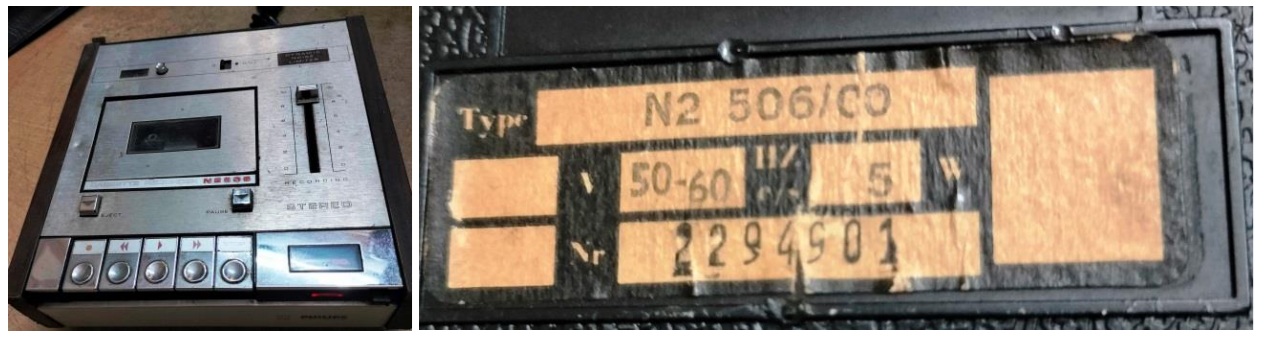
This is one among the seven sets brought by a new customer from a very faraway place. The player was dead on checking. You can have a clear look of this lovely piece in the following link and download its service manual from yet another given next:
https://www.radiomuseum.org/r/philips_casette_recorder_n250619.html
The fitting screws were missing and I could take out the entire unit from its wooden box. I removed the side where the Power Supply was for checking why the power was not getting on.
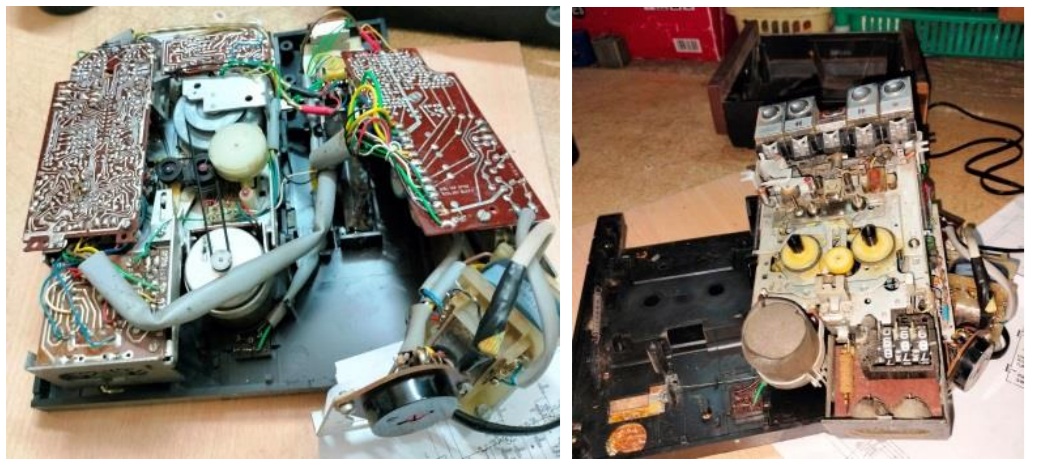
I noticed that the fuse was blown. Before replacing it, I wanted to check up whether there was some shorts which caused the fuse failure. So, took print outs of several pages of the circuit diagram and checked the boards and its active components using Analogue Multimeter. The method was checking the resistance in X1 range between ground and the supply point by two types of checking by red to ground and then black to ground. This will give a rough indication whether that stage has any problem, though not accurate. After doing this checking and making sure that there was no threat, I put the fuse and applied the power. But the power on indication lamp was not found lit. But the motor just started to run but stopped. I replaced all the belts as these can cause such hesitant running of the motor due to auto switch off activation.
On studying the function of the mechanism, I noticed that the set has an elaborate motor running sensor system involved. The collection side wheel had one rotating switch which makes and breaks the contact while the cassette is running and once it is stopped, the power supply to the motor gets cut off. Since the motor was starting but stopping immediately, I knew the problem was in the sensor. In order to check the contacts, I removed the lock and took out the collection wheel. Let us have a look at the inside:
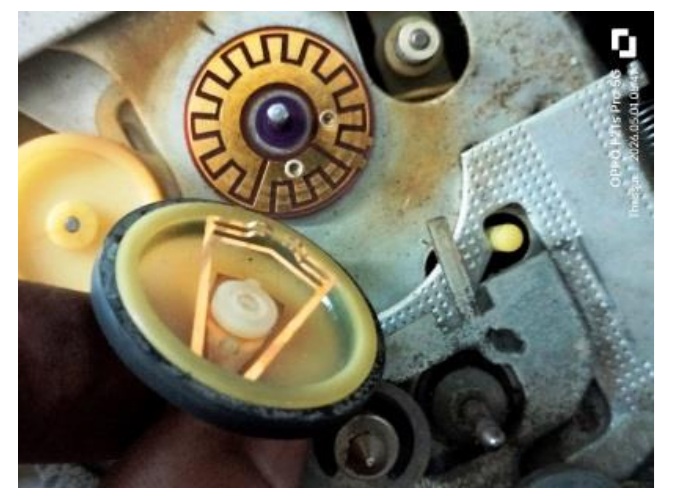
The pulse thus generated is sensed by the transistors which conduct if the wheel is stopped. Unlike the usual mechanisms, which engage many gear wheels or solenoid systems to control the mechanism, this is a very simple way of cutting the supply to motor. But the selected button such as Play/FF/REW or Rec remains pressed! Let us have a look at the circuit:
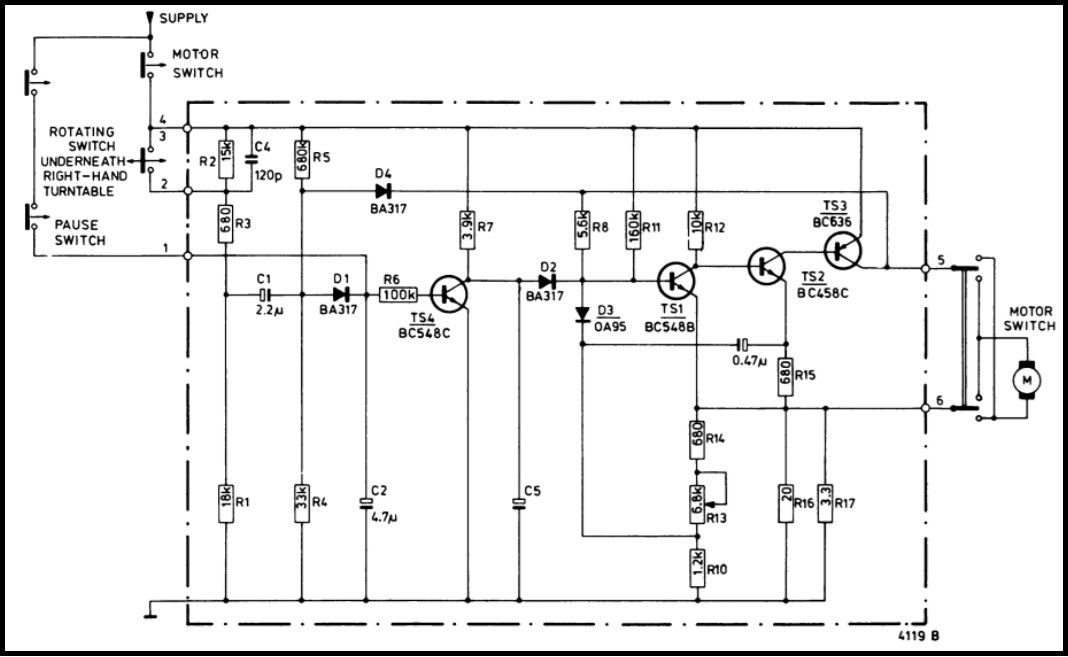
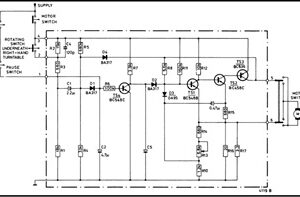
You will notice that the biasing is controlled by the switch for the driver transistor TS4 (BC548C). You can notice that even the pause switch functions as a bias cutting method to stop the motor. The delay in sensing is achieved by the C1 capacitor which holds charge while the rotating switch is away from a contact until it touches the next one. Otherwise the transistor will turn off in the short gap. This is a very interesting circuit and I do not know why many manufacturers resorted to very complicated electro-mechanical ways for achieving an auto-stop!
I replaced all the electrolytic caps in the motor control unit as these have very important function due to the peculiar circuit employed. After finishing this work, and re-fixing the collection wheel, I loaded a cassette and tried. I saw that the pinch roller was in a very bad condition. So replaced it. In order to do that, we have to take away the pinch roller, slide out the centre pin and put a suitable one which fits snugly without any abnormal play sideways. Let us have a look:
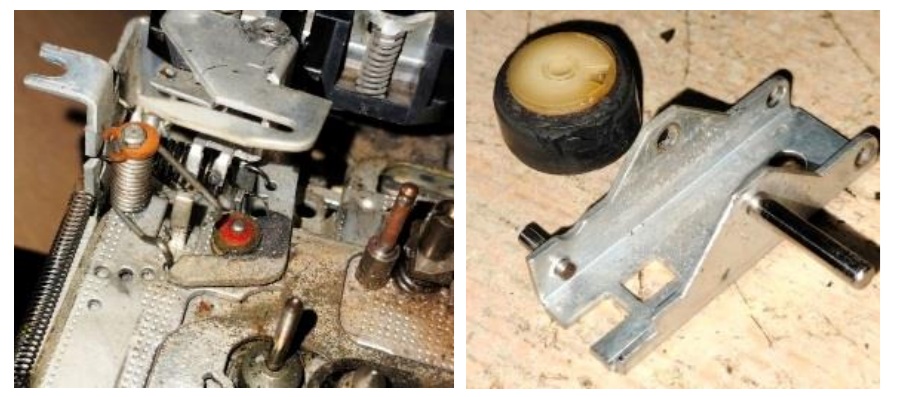
The precautions while doing such work is to ensure that the spring does not jump off and get lost. All these springs are made suitable for each function and we cannot replace it with any from our stock. The length, diameter, thickness, tension etc. should be so precise. Otherwise it will malfunction. The centre pin has one end slightly larger than the other and we should not hammer the larger part in. We have to hammer it from the other side. The larger part is to hold tight once the pin sits in properly. Tape recorder mechanisms are so complex that one small error can cause permanent damage to the mechanism. Even slight bend created while removing any mechanical part would cause irreparable damage. Then I once again loaded a cassette and it played very well. As this set does not have an Amp, I took it to my Pooja Room and played songs from different cassettes through my self-made Amplifier. The Din connection had to be adjusted inside the connector that I have for interface to suit the output in the set. The output of the Tape was amazingly superb! The next step was to find out why the power on indicator was not working. I opened that portion and found that the bulb had an open filament.
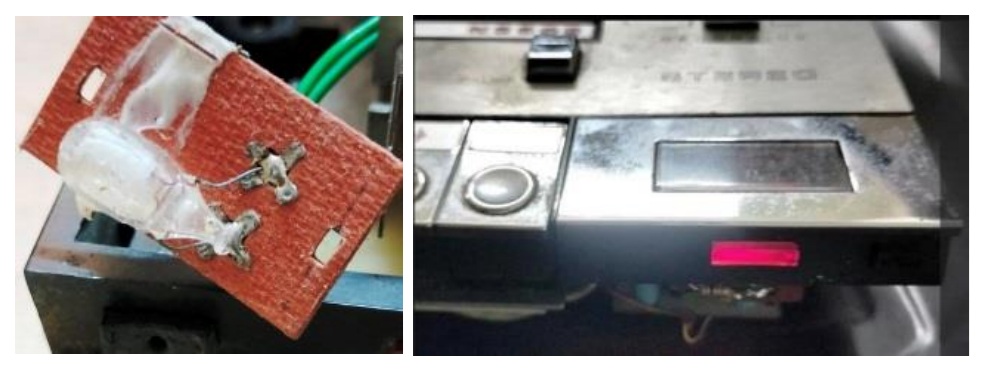
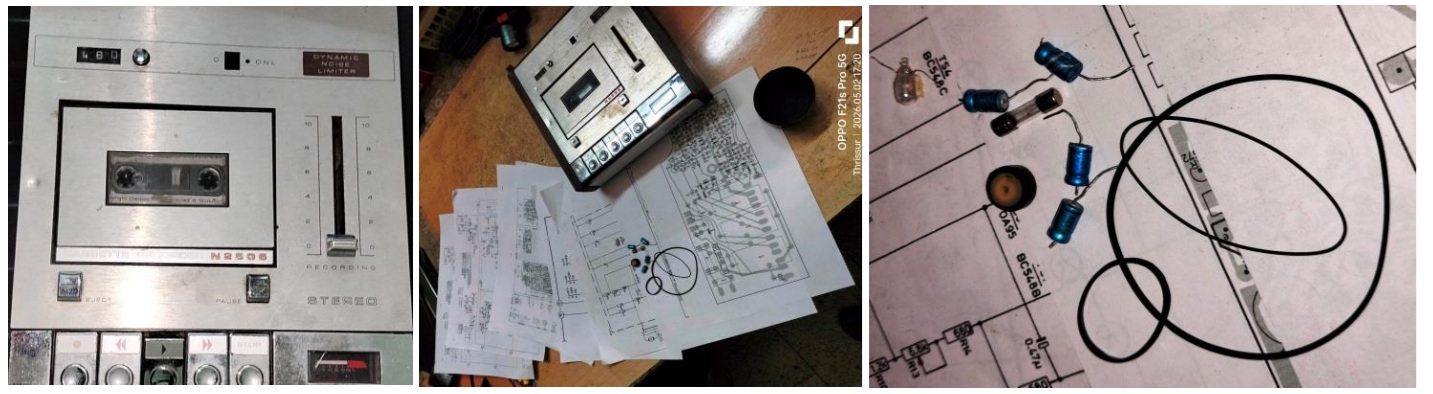
Since a suitable bulb was not available in the market, I connected an LED with a current dropping resistor, upon which the power on worked very well, as you can see from the second picture above. I played several cassettes both A & B recalling the good old days when it was a part and parcel of our life! Following are some more pictures of the number of sheets printed, the defective components replaced and the player in working mode:
Since the customer is an antique collector/dealer, I had to take care of the cost involved in servicing and that prevented me from carrying out a total restoration. Anyhow, mission accomplished which derived satisfaction, density of which got passed for obtaining entry into the satisfaction bag!
I think, one thing you all will notice is that the joy I get in working on such sets is definitely reflected in the way I explain these in my articles. Two things continue to provide amusement; first such antique sets, second writing about it in detail step by step, which serves as a study for me too! Only when we write down what we did, our mistakes, scope for improvements, alternative methods that could have employed etc. will surface and will serve as an educative effort.
Added to that is the expert comments made on every article published here in this great forum run by Jestine Yong. I am ever thankful to him for the support and encouragement he gives by publishing my articles, despite of his busy schedules. Au revoir!

This article was prepared for you by Parasuraman Subramanian from India. He is 76 years old and has more than 30 years’ experience in handling antique equipment like Valve Radio, Amps, Reel Tape Recorders and currently studying latest tech-classes conducted by Kerala State Electronics Technicians’ Association. He has done graduation in BBA degree, private diploma in Radio Engineering and retired as MD of a USA company. Presently working as Consultant to Hospital and other institutions.
Please give a support by clicking on the social buttons below. Your feedback on the post is welcome. Please leave it in the comments.
P.S-If you enjoyed reading this, click here to subscribe to my blog (free subscription). That way, you’ll never miss a post. You can also forward this website link to your friends and colleagues-thanks!
You may check on his previous article on Revisit Of USB-BT-FM Radio Model SPANIO WOODY
 (24)Dislikes
 (0)
(0)
10 Comments
Leave a Reply





Arun Kumar
August 8, 2026 at 10:42 am
Great Sir,
Getting spares ia the biggest problem, especially the drive belts,pinch roller.
Many sets are discarded just for such small items
Parasuraman S
August 8, 2026 at 3:22 pm
Many thanks for your comments! It is indeed a problem to get old spares!
Albert van Bemmelen
August 8, 2026 at 4:13 pm
This was another nice and well explained repair about a cassette-player from the good old days when Philips still was well known for selling and manufacturing all kinds of audio sets!
When audio was still only analog instead of todays digital playing and recording methods. When audio recording and playback still relied entirely on physical continuous uninterrupted electrical waveforms. Without todays options to compress any audio recording into about a tenth of its previous needed audio store volume we now know as MP3. Which for digital video recording we know as MP4.
And thanks for the link to the service manual of this N2506 set that always is interesting to be able to have a peek in its unique design.
Parasuraman S
August 8, 2026 at 5:54 pm
Many thanks for your delved into expert comments, dear Albert! I am happy that you found it usefl!
Mark J
August 9, 2026 at 2:52 am
Another great restoration. It is nice to see that there is other like minded people that like restoring these old tape players. Thanks again for sharing these.
Parasuraman S
August 9, 2026 at 5:38 pm
Many thanks for your support and comments, dear Mark!
Yogesh Panchal
August 9, 2026 at 7:46 pm
Good job!Sir,
The biggest task involved was extracting the film reel that used to get stuck between the pinch roller and the capstan roller.This is a very exciting job.
Parasuraman S
August 10, 2026 at 3:36 pm
Yes, indeed! Many thanks for your comments, dear Yogesh Bai!
AdamS
August 10, 2026 at 5:24 pm
Another excellent repair Parasuraman. It's always joy to read how you save these fine machines from extinction!
Parasuraman S
August 11, 2026 at 10:26 am
Many thanks for your encouraging comments!